Transporting your bike on a hitch rack offers unparalleled convenience, allowing you to carry multiple bikes without impacting roof clearance or vehicle aerodynamics. However, this convenience comes with a critical responsibility: ensuring your valuable bikes are safe from theft. A hitch rack, while sturdy, can present opportunities for opportunistic thieves if not properly secured. Understanding the vulnerabilities and implementing a robust locking strategy is paramount to protecting your investment. This guide will walk you through essential tools, step-by-step locking methods, and advanced DIY tips to keep your bikes safe on any journey.
Understanding Hitch Rack Security: Common Vulnerabilities
Before diving into locking techniques, it’s crucial to understand where a hitch rack system is most vulnerable to theft. Identifying these weak points allows you to create a comprehensive security plan that deters thieves effectively.
The Hitch Connection Point
|
Our Picks for the Best Bike Rack in 2026
As an Amazon Associate I earn from qualifying purchases.
|
||
| Num | Product | Action |
|---|---|---|
| 1 | monTEK Swivel Bike Wall Mount, Bike Hangers for Garage, Space-Saving Vertical Bike Rack, Sturdy Bike Storage Rack Holds Up to 66lbs, Easy to Install, 4 Pack |

|
| 2 | CHEPARK Bike Floor Stand Rack- Indoor Bike Stand for Garage/Home - Bike Storage Bicycle Parking Rack Fit 20”-29” Mountain Road Bikes (1 Bike Rack) |
|
| 3 | Vertical Bike Parking Stand - Adjustable Height for 29"Wheels, Space-Saving & Freestanding Bike Rack for MTB/Road Bikes,No-Drill Installation Indoor Bike Storage for Apartments & Garages |
|
| 4 | Vertical Bike Stand, Freestanding Bike Rack Garage Storage Upright Bicycle Floor Stand Indoor Bike Holder with Adjustable Height for Garage & Apartment - for Wheels Sizes up to 29” |
|
| 5 | KUAT Sherpa 2.0 Durable Lightweight Aluminum Compact 2 Bike Transporting Hitch Rack with Cable Lock & Foldable Tire Cradles | Capacity - 40 Lbs per Tray |
|
| 6 | 2 Bikes Floor Stand,Adjustable Bicycle Parking Rack with Hook for Garage/Indoor/Outdoor,Metal Cycle Storage Organizer Rack for Road Bikes |
|
| 7 | Vertical Bike Stand, Upright Bike Parking Rack Floor, Adjustable Bicycle Storage for Wheels Sizes up to 29", Freestanding Bicycle Organizer with Swivel Casters, Indoor Bike Holder for Garage 2-Pack |
|
| 8 | CyclingDeal Upright Bike Stand Floor - Vertical & Horizontal Bicycle Stand Bicycle Storage - Safe & Secure Bike Storage Rack - for Wheels Sizes up to 29" - Bike Rack Garage Bicycle Rack - Classic |
|
| 9 | Young Bike Rack Hitch for Car - 200LB 2-Bike Rack Hitch Mount Platform Style Hitch Bike Rack,Smart Tilting & Easy Fold for Car SUV with 2 Inch Receiver,Bike Carrier Fits Up to 5-inch Fat Tire |
|
| 10 | Allen Sports Deluxe 4-Bike Hitch Mount Rack (2-Inch Receiver) , Black |
|
The first point of attack is often the connection between the hitch rack and your vehicle’s receiver. Many racks use a standard hitch pin. While some include a locking hitch pin, these can sometimes be compromised with brute force, such as a hammer, potentially allowing the entire rack, with your bikes, to be removed.
Bike Frame to Rack Attachment
Once the rack itself is secure, the next vulnerability is how your bikes are attached to the rack. Most hitch racks have cradles or trays that hold the bike frames, often with straps or clamps. If there isn’t an integrated locking mechanism, or if it’s easily defeated, a thief could quickly unstrap and lift your bike off the rack.
Wheels and Quick-Release Components
Bikes frequently feature quick-release skewers on their wheels and seat posts. While convenient for adjustments and storage, these also make it incredibly easy for a thief to remove expensive components in seconds. Leaving wheels or seats unsecured essentially offers them as an open invitation for theft.
Overall Visibility and Environment
Even the most robust locks can be bypassed given enough time and the right tools. The location where you park your vehicle plays a significant role in its security. Isolated, poorly lit areas provide thieves with the cover they need to work undisturbed, increasing the risk of theft regardless of your locking setup.
Essential Locking Tools for Hitch Racks
A multi-layered security approach using various types of locks offers the best defense against bike theft. Each lock type has distinct advantages for different components of your bike and rack setup.
U-Locks
U-locks are widely regarded as one of the most secure bike locks. Their solid, horseshoe shape limits leverage points, making them difficult to cut with bolt cutters and resistant to hammering or chiseling. They are ideal for securing your bike’s frame to the hitch rack, or even locking multiple bikes together. Choose a U-lock with a high-security rating and ensure it’s large enough to fit around your frame and a sturdy part of the rack or another bike, while minimizing the internal space.
Chain Locks
Heavy-duty chain locks provide excellent security, often being more resistant to angle grinders than U-locks due to the movement of their links during cutting. They are less susceptible to leverage attacks and can be very versatile for wrapping around irregular shapes. While heavier and bulkier than U-locks, their flexibility allows them to secure both the frame and a wheel to the rack, or even loop through multiple bikes. Look for chains with hardened steel square links and a quality padlock.
Folding Locks
Folding locks offer a balance between security and portability. They consist of hardened steel bars connected by rivets, allowing them to fold into a compact shape for easy transport. When unfolded, they provide a decent length for securing bikes to racks or other objects. Many folding locks come with rubber coatings to protect your bike’s finish. While generally more secure than cable locks, their security level can vary significantly by brand and model.
Cable Locks
Cable locks are the most versatile but also the least secure primary locking option. Made from braided steel cables, they are lightweight and flexible, making them excellent for securing quick-release wheels, seats, or other accessories to your main frame or the rack. However, they are relatively easy to cut with bolt cutters. Therefore, cable locks are best used as a secondary deterrent in conjunction with a U-lock, chain, or folding lock, or for situations where a higher level of security isn’t critical.
Hitch Pin Locks
These specialized locks replace the standard hitch pin, preventing the entire bike rack from being removed from your vehicle’s receiver. While they offer a basic layer of security for the rack itself, it’s wise to consider them as just one component of your overall defense. Some locking hitch pins are more robust than others, but none are foolproof on their own.
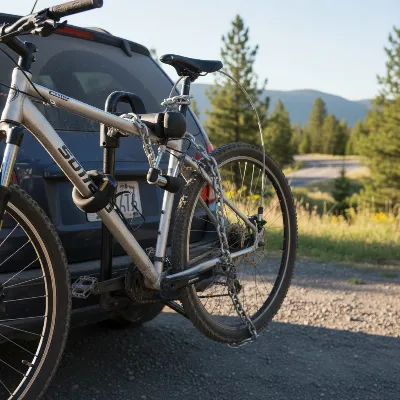 Various bike locks, including a U-lock, chain lock, and cable lock, securing bicycles to a hitch rack.
Step-by-Step DIY Guide to Locking Your Bikes
Implementing a smart, multi-layered locking strategy doesn’t have to be complicated. Follow these steps to maximize the security of your bikes on a hitch rack.
1. Secure the Hitch Rack to the Vehicle
This is your first line of defense. Always use a locking hitch pin to prevent the entire rack from being easily detached. For an added layer of DIY security, consider running a long, heavy-duty cable or chain from a sturdy point on your vehicle’s subframe or chassis, through a part of the hitch rack, and securing it with a high-quality padlock. This makes it harder for thieves to simply unbolt the hitch itself and drive off with the entire assembly.
2. Primary Lock Strategy: Frame to Rack (and Rear Wheel)
The bike frame is the most valuable part of your bicycle, so it should be the focus of your strongest lock.
- For one bike: Use a U-lock or a robust chain lock to secure the bike’s frame directly to the most immovable part of the hitch rack. Aim to pass the lock through a main triangle tube of the frame (like the seat tube or down tube) and around a substantial metal part of the rack.
- Pro Tip: If your U-lock or chain is long enough, try to also include the rear wheel when securing the frame to the rack. This is often possible by positioning the U-lock through the rear triangle of the frame and the rim of the wheel, then around the rack. This secures two critical components with one primary lock.
3. Secondary Lock Strategy: Front Wheel and Accessories
With the frame and rear wheel (if possible) secured by your primary lock, turn your attention to the front wheel and any quick-release accessories.
- Front Wheel: Use a strong cable lock to loop through the front wheel and either connect it to your primary U-lock/chain, or wrap it around the bike’s frame and secure it to the rack. If you’re parking for an extended period in a high-risk area, consider removing the front wheel and placing it next to the rear wheel, then securing both wheels and the frame with your primary lock.
- Seat and other quick-release parts: If your seat has a quick release and is valuable, either remove it and take it with you or use a small cable lock to secure it to the frame. The same applies to any quick-release bike computers, lights, or bags; it’s always safest to remove these items.
4. Multiple Bikes: Layering Security
If you’re carrying multiple bikes, the “one lock, one bike” rule still largely applies, but you can be strategic.
- Chain through frames: Use a long, heavy-duty chain lock to weave through the frames of all bikes and secure it to the hitch rack. This acts as a strong deterrent for the entire group.
- Individual locks: Supplement the main chain with individual U-locks or folding locks for each bike, securing its frame to the rack or to an adjacent bike’s frame.
- Minimize gaps: Always strive to leave as little open space within your locks as possible. Tight locks are harder for thieves to use leverage tools against.
- Elevate locks: Position all your locks as high off the ground as possible. This makes it harder for thieves to use the ground for leverage or to smash locks.
Advanced DIY Security Tips & Best Practices
Beyond specific locking tools, several practical strategies can significantly enhance the security of your bikes on a hitch rack.
Strategic Parking Choices
Where you park is almost as important as how you lock.
- Visibility and lighting: Always choose a well-lit, high-traffic area. Thieves prefer to operate under the cover of darkness or in secluded spots.
- Back up to an obstacle: If possible, back your vehicle up very close to a wall, sturdy pole, or another large, stationary object. This limits access to the rear of your hitch rack, making it much harder for thieves to maneuver and work on the locks.
- Avoid overnight parking: Whenever feasible, avoid leaving bikes on a hitch rack overnight, especially in unfamiliar or high-risk locations. If you must, bring the bikes inside your accommodation.
Removing Valuable Components
Make your bike less appealing to opportunistic thieves by removing easily detachable and valuable items. This includes:
- Bike computers and GPS devices
- Front and rear lights
- Water bottles
- Seat bags
- Quick-release seats (or replace quick-release skewers with bolt-on versions for added security)
Bike Registration and Identification
While not a direct theft prevention method, registering your bike can be crucial for recovery.
- Serial Number: Note down your bike’s serial number (usually found on the bottom bracket). This is vital for police reports.
- Registration Databases: Register your bike with national databases like Project 529 Garage or Bike Index. These platforms help identify stolen bikes and connect them with their owners.
- Personalization: Make your bike unique. A distinctive paint job, stickers, or unique accessories can make your bike less generic and harder for thieves to sell unnoticed.
Regular Inspection and Maintenance
Periodically check your locks and security setup.
- Lock Condition: Ensure your locks are functioning correctly, keys turn smoothly, and combinations are memorable but secure. Lubricate mechanisms as needed.
- Rack Integrity: Confirm that your hitch rack is securely mounted to your vehicle and all its parts are in good condition.
“True bike security isn’t about making your bike unstealable; it’s about making it harder to steal than the next one. A layered approach using multiple types of high-quality locks is the most effective deterrent.” – Alex Stone, Cycling Security Expert
Choosing the Right Security Gear: A Buying Guide
Selecting the right security tools is a critical step in safeguarding your bikes. Consider these factors when making your choices.
Factors to Consider
- Security Rating: Look for locks with independent security ratings, such as Sold Secure (Gold, Silver, Bronze) or ART (2, 3, 4, 5 stars). Higher ratings indicate greater resistance to various attack methods.
- Material and Construction: Hardened steel is standard for high-security locks. Pay attention to shackle thickness for U-locks and link thickness for chains. Look for features like disc detainer cylinders for pick resistance.
- Size and Length: Choose a U-lock that is compact enough to minimize internal space when locked but large enough to fit around the frame and rack. For chains and cables, ensure they are long enough to comfortably reach all necessary locking points without being excessively long and cumbersome.
- Weight: Consider the weight, especially if you plan to carry the locks with you on rides. Heavier locks often mean more material and therefore more security.
- Key vs. Combination: Keyed locks are generally considered more secure than combination locks, as they don’t have easily guessable codes. However, combinations offer key-free convenience.
- Integrated Locks: Many premium hitch racks feature integrated cable locks. While convenient, assess their security level. They are often suitable for quick stops but should be supplemented with external locks for extended parking.
Recommended Brands and Types
Leading brands known for their robust bike security products include:
- ABUS: Renowned for high-security U-locks (e.g., Granit X-Plus) and folding locks (e.g., Bordo series).
- Kryptonite: Offers a wide range of U-locks (e.g., New York Fahgettaboudit), chains (e.g., Evolution), and cable locks.
- Litelok: Known for innovative, lightweight, and angle-grinder-resistant locks (e.g., X1, X3).
- OnGuard: Provides a good balance of security and value across U-locks and chains (e.g., RockSolid, Mastiff).
- Hiplok: Specializes in wearable chain locks and highly secure U-locks (e.g., D1000).
When purchasing, prioritize a high-security U-lock or chain lock for your primary defense, and a strong, vinyl-coated cable lock for secondary security. Always opt for the highest security rating within your budget and needs.
Conclusion
Securing your bikes to a hitch rack requires a proactive and strategic approach. By understanding the common vulnerabilities and employing a layered security system, you can significantly reduce the risk of theft. Combining high-quality locks—like a robust U-lock or chain for your frame and wheels, complemented by a cable lock for quick-release components—with smart parking choices and diligent habits, forms an impenetrable defense. Remember, the goal is to make your bike a less appealing target than the one next to it. Don’t let the fear of theft overshadow the joy of cycling; equip yourself with the knowledge and tools to protect your ride.
What locking strategies have worked best for you when transporting bikes on a hitch rack?
Câu Hỏi Thường Gặp
What is the most important part of my bike to lock on a hitch rack?
The bike frame is the most crucial component to secure. Always prioritize locking the frame directly to the hitch rack using your strongest lock, as it is the most valuable and defining part of your bicycle.
Can integrated hitch rack locks be trusted on their own?
Integrated locks offer convenience but are generally considered a deterrent for opportunistic thieves rather than a high-security solution. For peace of mind and enhanced protection, always supplement integrated locks with independent, high-quality U-locks, chains, or folding locks.
How many locks do I need for multiple bikes on a hitch rack?
For multiple bikes, a combination of locks is recommended. Use a long, heavy-duty chain or cable to weave through all bike frames and the rack, and then use individual U-locks or folding locks for each bike, securing its frame and at least one wheel.
Is it worth removing my quick-release wheels when using a hitch rack?
If you’re parking for an extended period in a high-risk area, removing your quick-release front wheel and securing it with your main lock through the frame and rear wheel can be a wise extra precaution. This eliminates an easy target for thieves.
What are some simple DIY actions to deter thieves besides locks?
Parking strategically can be very effective. Backing your vehicle up against a wall or pole restricts access to the rack, making it harder for thieves to operate. Choosing well-lit, visible areas also significantly reduces the risk.
