Embarking on an RV adventure means freedom, open roads, and the joy of discovery. For many, that joy is amplified by bringing along bicycles to explore new trails and scenic routes. However, transporting bikes on a travel trailer isn’t as simple as attaching a standard car rack. The unique dynamics of RV travel demand specialized equipment designed to withstand extreme conditions, ensuring both your bikes and your peace of mind remain secure throughout the journey. Choosing the right RV hitch bike rack is a critical decision that can make or break your cycling adventures on the road.
Understanding RV Hitch Bike Racks: Why They’re Different
The world of bike racks has a clear distinction when it comes to RVs and travel trailers. What works flawlessly for your car or SUV can lead to catastrophic failure when subjected to the rigors of an RV trip. Understanding these differences is paramount to selecting a rack that will protect your investment and ensure safe travel.
The Unique Challenges of RV Travel
|
Our Picks for the Best Bike Rack in 2026
As an Amazon Associate I earn from qualifying purchases.
|
||
| Num | Product | Action |
|---|---|---|
| 1 | CHEPARK Bike Floor Stand Rack- Indoor Bike Stand for Garage/Home - Bike Storage Bicycle Parking Rack Fit 20”-29” Mountain Road Bikes (1 Bike Rack) |

|
| 2 | Young Bike Rack Hitch for Car - 200LB 2-Bike Rack Hitch Mount Platform Style Hitch Bike Rack,Smart Tilting & Easy Fold for Car SUV with 2 Inch Receiver,Bike Carrier Fits Up to 5-inch Fat Tire |
|
| 3 | monTEK Swivel Bike Wall Mount, Bike Hangers for Garage, Space-Saving Vertical Bike Rack, Sturdy Bike Storage Rack Holds Up to 66lbs, Easy to Install, 4 Pack |
|
| 4 | KUAT Sherpa 2.0 Durable Lightweight Aluminum Compact 2 Bike Transporting Hitch Rack with Cable Lock & Foldable Tire Cradles | Capacity - 40 Lbs per Tray |
|
| 5 | Allen Sports Deluxe 4-Bike Hitch Mount Rack (2-Inch Receiver) , Black |
|
| 6 | Vertical Bike Stand, Freestanding Bike Rack Garage Storage Upright Bicycle Floor Stand Indoor Bike Holder with Adjustable Height for Garage & Apartment - for Wheels Sizes up to 29” |
|
| 7 | Vertical Bike Parking Stand - Adjustable Height for 29"Wheels, Space-Saving & Freestanding Bike Rack for MTB/Road Bikes,No-Drill Installation Indoor Bike Storage for Apartments & Garages |
|
| 8 | 2 Bikes Floor Stand,Adjustable Bicycle Parking Rack with Hook for Garage/Indoor/Outdoor,Metal Cycle Storage Organizer Rack for Road Bikes |
|
| 9 | CyclingDeal Upright Bike Stand Floor - Vertical & Horizontal Bicycle Stand Bicycle Storage - Safe & Secure Bike Storage Rack - for Wheels Sizes up to 29" - Bike Rack Garage Bicycle Rack - Classic |
|
| 10 | Vertical Bike Stand, Upright Bike Parking Rack Floor, Adjustable Bicycle Storage for Wheels Sizes up to 29", Freestanding Bicycle Organizer with Swivel Casters, Indoor Bike Holder for Garage 2-Pack |
|
Travel trailers and RVs experience a far harsher environment on the road than passenger vehicles. The primary culprits are heightened vibration, intense G-forces, and the ‘lever arm’ effect. Travel trailer suspension systems, often composed of undamped leaf springs, transmit approximately four times more vibration to the rear of the vehicle compared to the smoother ride of a car. Every bump, pothole, and road imperfection translates into violent shaking that can quickly wear down conventional bike racks. For bike racks buying guides on this site.
Adding to this stress are the G-forces. When a travel trailer hits a railroad crossing or dips into a significant pothole, it can experience forces up to 8 Gs. Imagine a rack carrying two 40-pound bikes: that 130-pound setup suddenly generates over 1,000 pounds of force, attempting to rip the rack from its mounting point. The extended distance from an RV’s rear axle to its hitch receiver creates a longer “lever arm” that significantly amplifies these forces, putting immense strain on the rack. These unique stresses are why many manufacturers explicitly void warranties if their standard car racks are used on RVs or travel trailers.
RV-Approved vs. Standard Racks
An “RV-approved” or “travel-trailer rated” bike rack is not merely a marketing term; it signifies a product engineered to endure these extraordinary forces. These racks feature heavier steel construction, reinforced welds, and robust designs built to handle the constant bouncing and sway of RV travel. Unlike their car counterparts, RV-specific racks often incorporate enhanced stability features like anti-rattle hitch pins or integrated anti-wobble mechanisms to eliminate movement within the hitch receiver, preventing premature wear and potential failure.
Hitch compatibility is a crucial factor. Most RV-rated racks are designed for Class II (minimum 2-inch receiver) or Class III hitches, which offer the necessary structural integrity and tongue weight capacity. Class I (1.25-inch) hitches typically have lower weight limits and are generally not suitable for travel trailers due to the increased stress. Always verify your travel trailer’s hitch rating and ensure it matches the requirements of your chosen bike rack.
Types of RV Hitch Bike Racks
While various bike rack types exist for RVs, hitch-mounted racks are generally the most popular and often the most stable option for travel trailers. These attach directly to your trailer’s hitch receiver, offering robust support. Within the hitch-mounted category, two primary styles dominate: platform and hanging.
Platform-Style Racks
Platform-style hitch racks are widely considered the gold standard for RV and travel trailer use, particularly for heavier bikes like e-bikes and fat bikes. These racks feature trays or channels where each bicycle’s wheels rest, securing the bike at multiple points (wheels and often a frame or wheel clamp).
-
Pros:
- Superior Stability: Bikes are fully supported from below, minimizing movement and stress during transit.
- E-bike Friendly: High weight capacities (often 60-80 lbs per bike) are common, making them ideal for heavy electric bicycles.
- No Frame Contact: Bikes are typically held by their wheels and/or tires, preventing paint scratches or damage to carbon frames.
- Easier Loading: Bikes are lifted a shorter distance onto the platform, simplifying the loading process.
-
Cons:
- Can be heavier and more expensive than hanging racks.
- May extend further from the rear of the trailer, increasing overall length.
-
When to Use: Opt for a platform-style rack if you transport valuable bikes, e-bikes, fat bikes, or frequently load/unload your bicycles. They offer maximum protection and stability, essential for long RV journeys.
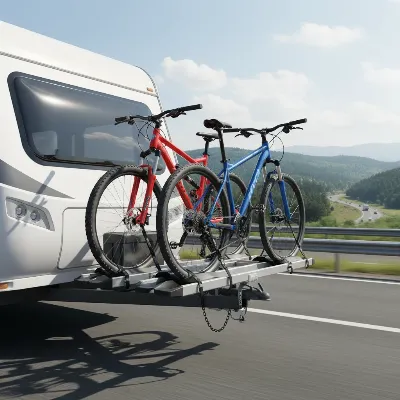 An RV hitch-mounted platform bike rack securely carrying two mountain bikes on the back of a travel trailer during a sunny road trip.
Hanging-Style Racks
Hanging-style hitch racks suspend bikes by their top tubes from arms extending horizontally from the hitch receiver. While simpler and often more affordable, they come with specific considerations for RV use.
-
Pros:
- Generally lighter and more compact when folded for storage.
- Can be a more budget-friendly option.
-
Cons:
- Frame Contact: Bikes hang from the frame, which can lead to scratches or rubbing, especially during high vibration.
- Limited Bike Compatibility: Bikes with unique frame geometries (e.g., step-through, full-suspension, or kids’ bikes) may require a top-tube adapter.
- Lower Weight Capacity: Typically have lower per-bike weight limits (e.g., 30-37.5 lbs per bike), making them less suitable for e-bikes.
- Potentially less stable on rough RV roads compared to platform racks.
-
When to Use: A hanging-style rack might be suitable if you transport lighter, traditional bicycles, prioritize a lower cost, and don’t mind using frame adapters for certain bikes. Ensure the model is explicitly RV-rated and you don’t exceed its weight limits.
Top-Rated RV Hitch Bike Racks for Travel Trailers 2026
When it comes to selecting a reliable RV hitch bike rack for your travel trailer, certain brands consistently rise to the top for their robust construction and RV-specific design. Here’s a look at some of the best options available in 2026.
Swagman RV-Approved Racks
Swagman is a standout brand with a strong reputation for producing truly RV-approved bike racks. They understand the unique demands of travel trailer towing and design their products to withstand those stresses.
- Key Features: Swagman racks often feature heavy-duty steel construction, powder-coated finishes for durability, and crucial anti-rattle threaded hitch pins that secure the rack tightly to the receiver, minimizing movement.
- Recommended Models:
- Swagman Traveler XC2 RV Approved Hitch Mount Bike Rack: A popular choice for its build quality and ease of use, mounting to a 2-inch Class 3 hitch receiver. It accommodates various bike types but is not ideal for heavy e-bikes or fat bikes.
- Swagman Escapee RV E-bike Approved Hitch Mount Bike Rack: This robust platform rack can carry two 60-pound e-bikes, making it excellent for heavier models. It offers strong security features, including a locking threaded hitch pin and locking hooked arms.
Yakima RV-Specific Racks
Yakima is another respected name in the bike rack industry, offering several models approved for RV use. They often provide clear guidelines on RV compatibility.
- Key Features: Yakima racks are known for features like StrongArm hooks that secure wheels without frame contact, and tool-free SpeedKnobs for easy and secure hitch attachment. Yakima is also notable for often not reducing the weight capacity per bike when their approved racks are used on RVs.
- Recommended Models:
- Yakima OnRamp LX 2”: An e-bike friendly platform rack designed to carry two bikes up to 80 lbs each. Its ramp accessory makes loading heavy e-bikes significantly easier.
- Yakima StageTwo 2”: A premium platform rack capable of carrying two bikes up to 70 lbs each. It builds on previous designs with enhanced stability and security.
- Yakima LongHaul: A 4-bike, RV-specific hanging style rack, rated for 37.5 lbs per bike.
Thule RV-Compatible Options
Thule is a global leader in transport solutions, with select bike racks deemed suitable for RVs, often with specific caveats regarding weight capacity.
- Key Features: Thule racks are recognized for user-friendly designs, such as convenient tilt-release handles and effective anti-wobble systems.
- Recommended Models:
- Thule Range RV 4-Bike Hitch Rack: This is one of the few hanging racks specifically designed for RVs, capable of carrying four bikes up to 37.5 lbs each, with a total load capacity of 150 lbs, without weight reduction.
- Thule Verse 2”: A premium platform rack that can carry two bikes up to 60 lbs each. However, when used on RVs, Thule specifies a 40% weight reduction, meaning its effective capacity is lower than for standard vehicle use. Users should carefully verify the reduced capacity against their bike weights.
Other Notable Brands for RV Use
Beyond the industry giants, several other manufacturers offer robust solutions for RV bike transport:
- 1Up USA: Known for its modular, heavy-duty aluminum construction and excellent anti-wobble design, 1Up USA racks (like the Heavy Duty or Super Duty) are popular among RV owners for their durability and ease of use.
- Let’s Go Aero: This brand offers purpose-built RV solutions, including their TwinTube™ platform racks, which are designed for maximum stability on travel trailers, and Jack-IT® A-frame racks that mount over the trailer’s A-frame, minimizing sway and vibration.
- Kuat: While many Kuat racks are high-quality, it’s crucial to check their RV-specific ratings. The Kuat Piston Ion is noted for e-bikes and RVs. The Kuat Transfer V2 is often limited to a reduced capacity (e.g., 40 lbs per bike) when used on an RV.
- HYPERAX Volt RV Hitch Mounted E-bike & Fatbike Rack: Specifically designed for heavy e-bikes and fat bikes, accommodating up to 70 lbs per bike.
- Curt Aluminum Tray-Style: A strong, relatively lightweight platform rack that can hold two bikes with a high total weight capacity, featuring an anti-rattle knob for stability.
> “The single most important factor for an RV bike rack is its explicit ‘RV-approved’ rating. Without it, you’re not just risking your bikes, you’re risking a serious roadside incident.” – Admin, ReviewRevise.com, Expert Technician in Bike Racks
Essential Factors When Choosing Your RV Hitch Bike Rack
Selecting the ideal RV hitch bike rack for your travel trailer involves careful consideration of several key factors that go beyond just carrying your bikes.
Bike Capacity and Weight Limits
Determine how many bikes you plan to transport, both now and in the future. Most RV hitch racks carry two to four bikes. Crucially, always check the per-bike weight capacity, not just the total capacity. Electric bikes (e-bikes) can weigh between 50-80 pounds each, significantly more than traditional bikes (25-30 pounds). Using a rack with insufficient per-bike capacity for e-bikes can lead to rack failure and bike damage. Many standard racks simply cannot handle the combined weight and stress of e-bikes on an RV.
Hitch Compatibility and Receiver Size
Your travel trailer’s hitch receiver must be compatible with the bike rack. Most RV-approved hitch racks require a 2-inch receiver, corresponding to a Class II or Class III hitch. Always verify your RV’s hitch class and tongue weight rating against the rack’s specifications. A proper fit is essential for safety and stability; ensure the rack features an effective anti-wobble mechanism or a threaded hitch pin to eliminate play within the receiver.
Durability and Construction Materials
The extreme vibration and forces of RV travel necessitate a rack built for superior durability. Look for racks constructed from heavy-duty steel with reinforced welds and a robust powder-coated finish for weather resistance. Avoid racks with too many plastic components or lightweight designs not explicitly rated for RV use, as they are prone to premature failure under these conditions.
Ease of Use and Accessibility
Consider how easily you can load and unload your bikes. Platform racks often simplify this process due to their lower lift height. Some racks offer tilt or swing-away features, allowing access to the rear of your travel trailer even with bikes loaded. However, it’s critical to note that hitch extensions and swing-away adapters are generally not recommended for RV use as they increase motion and stress on the hitch. Always use an anti-rattle hitch device if one isn’t integrated into the rack.
Security Features
Protecting your valuable bikes from theft is important. Look for racks with integrated locking mechanisms, such as cable locks that secure bikes to the rack and locking hitch pins that secure the rack to your RV. While cable locks offer basic deterrence, a threaded hitch pin provides an additional layer of security by preventing the rack from being easily removed. For e-bikes, consider removing batteries during transport to reduce weight and theft risk.
Comparison Table: Top RV Hitch Bike Racks
To help visualize the differences between popular RV hitch bike racks, here’s a detailed comparison:
| Feature | Swagman Traveler XC2 (RV-Approved) | Yakima OnRamp LX (RV-Approved) | Thule Range RV (RV-Approved) | Kuat Transfer V2 (RV-Compatible) | Hollywood Racks RV Rider (Motorhome/5th Wheel ONLY) |
|---|---|---|---|---|---|
| Type | Platform | Platform | Hanging | Platform | Platform |
| Bike Capacity | 2 | 2 | 4 | 2 (add-on for 3) | 2 |
| Per Bike Wt. (RV) | 35 lbs | 80 lbs | 37.5 lbs | 40 lbs (with 40% reduction) | 80 lbs |
| Hitch Size | 2″ Class 3 | 2″ | 2″ | 2″ | 2″ Class 3 |
| E-bike Friendly | No (use Escapee for e-bikes) | Yes | No (due to weight) | Limited (check weight) | Yes |
| Anti-Rattle | Threaded hitch pin | SpeedKnob | Yes | Integrated | Locking frame grabbers, wheel holders |
| Security | Locking hitch pin, cable locks | Integrated SKS locks | Integrated cable, STL2 bolt | Integrated hitch lock, cable | Locking frame grabbers |
| Special Notes | Can use bumper adapter | No weight reduction for RV use | Full 150 lbs load capacity | RV use with 40% weight reduction | Not suitable for travel trailers; best for motorhomes/5th wheels |
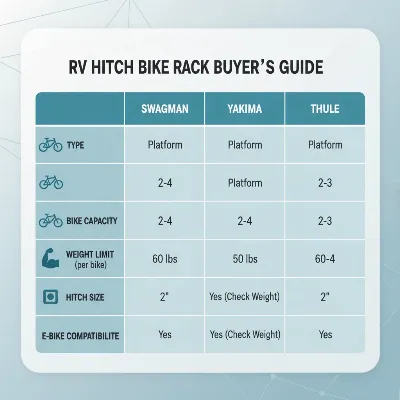 An infographic or illustrative chart comparing features of various RV hitch bike racks suitable for travel trailers.
Installation and Maintenance Tips
Proper installation and consistent maintenance are crucial for the longevity and safety of your RV hitch bike rack and your bikes. Taking a few proactive steps can prevent issues down the road.
Pre-Installation Checks
Before installing any bike rack, thoroughly inspect your travel trailer’s hitch receiver. Ensure it is free of rust, damage, or excessive play. Confirm its class rating matches or exceeds the requirements of your chosen RV-approved rack. Always review the manufacturer’s specific instructions for your bike rack model, as RV-approved racks often have unique installation nuances. If your hitch connection feels loose, use a high-quality anti-rattle hitch tightener or an integrated anti-rattle hitch pin to secure the rack firmly in place.
Securing Your Bikes
Once the rack is installed, proper bike loading is essential. For platform racks, ensure bikes are seated correctly in the wheel trays and secured with all available clamps and straps. For hanging racks, use anti-sway cradles and additional straps to prevent bikes from swinging and contacting each other or the trailer. For e-bikes, always remove their heavy batteries before transport to significantly reduce the overall weight on the rack and eliminate theft risk. Double-check all straps and locking mechanisms before every departure.
Regular Maintenance
Like any outdoor equipment, your RV hitch bike rack requires routine maintenance to remain in top condition. After each trip, especially those involving dirt roads or adverse weather, clean the rack to remove dirt, grime, and road salt. Periodically inspect all bolts, pins, and connection points for tightness and signs of wear or fatigue. Lubricate moving parts, such as tilt mechanisms or ratcheting hooks, to ensure smooth operation. Store your rack in a dry place when not in use to prevent rust and extend its lifespan.
Conclusion
Choosing the best RV hitch bike rack for your travel trailer is a crucial decision for any cycling enthusiast who loves to explore while on the road. The unique stresses of RV travel – amplified vibration, G-forces, and the lever arm effect – demand a rack specifically designed and rated for such conditions. Prioritizing RV-approved models, especially robust platform-style racks with high per-bike weight capacities and effective anti-rattle features, will ensure your bicycles are transported securely and safely. By carefully considering bike capacity, hitch compatibility, durability, ease of use, and security, you can confidently select a rack that not only meets your needs but also enhances your overall RV and cycling adventures.
What unforgettable cycling destinations will your new RV hitch bike rack take you to first?
Frequently Asked Questions
What makes a bike rack “RV-approved”?
An “RV-approved” bike rack is specifically designed and tested by the manufacturer to withstand the intense vibration, G-forces, and unique leverage experienced when mounted on an RV or travel trailer. These racks feature heavier-duty construction, reinforced welds, and specialized anti-rattle mechanisms, unlike standard car bike racks.
Can I use a regular car bike rack on my travel trailer?
No, it is highly inadvisable to use a regular car bike rack on a travel trailer. Standard racks are not built to handle the significantly higher vibration and G-forces inherent in RV travel, which can lead to premature failure, damage to your bikes or trailer, and even void the rack’s warranty.
How many bikes can an RV hitch rack typically carry?
Most RV hitch bike racks are designed to carry two to four bicycles. It’s essential to check both the total weight capacity and the individual per-bike weight limit, especially if you plan to transport heavier e-bikes or fat bikes.
Are platform or hanging style racks better for RVs?
Platform-style racks are generally considered superior for RVs, particularly for e-bikes, as they fully support bikes by their wheels, reducing stress on frames and components. They offer greater stability and often higher weight capacities compared to hanging racks, which suspend bikes by their top tubes.
Is it safe to carry e-bikes on an RV hitch rack?
Yes, it is safe to carry e-bikes on an RV hitch rack, provided you choose a rack explicitly rated for the weight of your e-bikes (typically 60-80 lbs per bike) and explicitly RV-approved. Always remove e-bike batteries before transport to reduce overall weight and potential theft risk.
What hitch class do I need for an RV bike rack?
Most RV-approved hitch bike racks require a 2-inch receiver, which corresponds to a Class II or, more commonly, a Class III hitch. Class I (1.25-inch) hitches typically have lower weight limits and are not recommended for the demanding conditions of travel trailer use.
